Tuesday, 7 January 2014

Sunday is a day of...

Hot on the heels of last year’s ‘Happy Hour’ on Red Arrow, Sundays in January see an hour of free travel across the Trent Barton network. It’s a scheme called “Free Ride Sunday” and it’s designed to get more people on the buses and into the city centre on what has traditionally been a day where people have stayed at home.


People’s general attitudes towards Sunday being a “day of rest” have massively changed. The number of people who would consider themselves Christians decreased by 4 million between 2001 and 2011 according to census figures, whilst the proportion of people who considered themselves to have no religion increased by 10% to a quarter of the population. From my own personal experience of working in retail, it is not uncommon for us as a shop to take just as much, if not more on a Sunday than the Saturday before, despite 3 hours fewer trading. Sunday is therefore, it seems, becoming the new Saturday.

Free Ride Sunday follows on from Happy Hour, trialled last year on the Red Arrow

But there are a few factors holding it back. Sunday trading hours, for one thing. Large shops (over 280 square feet) are restricted to just 6 consecutive hours of trading which discourages smaller shops from opening for much more; it is the larger shops that draw the customers into the retail destinations. Secondly, public transport links are nowhere near as good on a Sunday as any other day of the week. Very few bus or train routes run to the same timetable on a Sunday, with some routes seeing no service at all. Many that do run rely on a council subsidy or use truncated routes in order to be sustainable.

Sunday is a day of rest shopping! It's a message that Trent Barton have been encouraging for a while

But things do seem to be getting better, Swift finally saw a Sunday service last year after years of sister company TM Travel running an alternative service. The Threes saw an increase from two buses an hour to three on a Sunday along key sections of the route. And perhaps Trent Barton’s latest venture shows that they believe there is potential in a more comprehensive Sunday service, if more people can be convinced to go into the towns and cities at the end of the week. In the official press release, Commercial Director Alex Hornby comments “In recent years Sunday has also become an increasingly important shopping day, and by taking up the offer customers can also enjoy a little extra money in their pocket to spend in the January sales!”
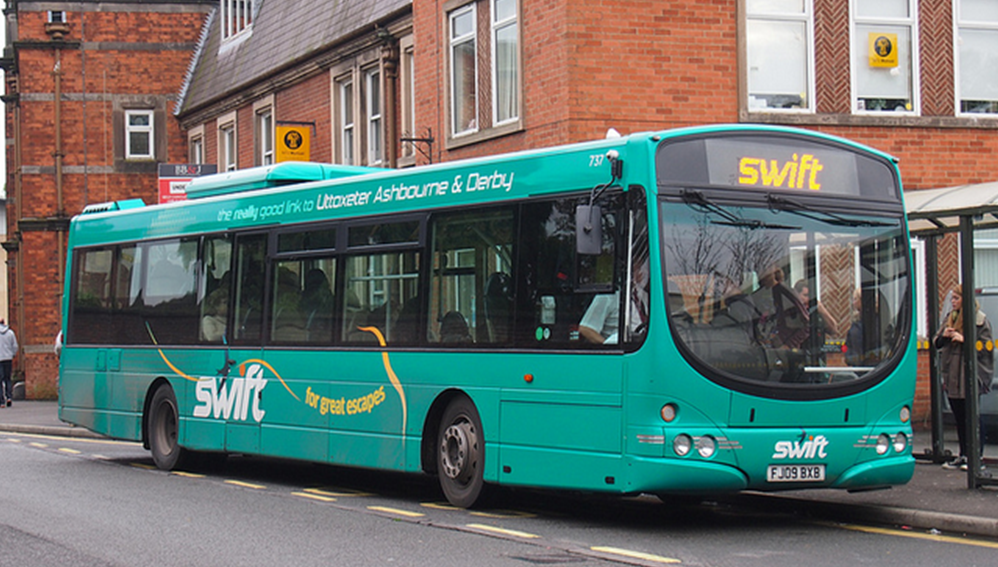
Swift only became a 7-day-a-week operation last year, but on a much reduced timetable and a truncated route

There is, of course, another incentive for the operator. It will get more people to try the bus as a means of transport.  Many people still stereotype buses as being like something out of the sitcom “On the Buses,” dirty, dingy and not nice things to be on. Whilst certain operator’s vehicles may way still live up to that stereotype, the vast majority of Trent’s don’t. Customers may well be pleasantly surprised on how advanced buses have become, particularly considering recent additions such as air conditioning and Wi-Fi.  On this, Alex comments “In 2014 we want to see more people discover the comfort, convenience and value for money that our friendly, frequent buses provide while helping to cut congestion on our busy roads.” All it takes is a few individuals to swap to bus travel from the car for the scheme to break even, which if nothing else will be a nice treat for regular customers, which may encourage loyalty at a time of heavy competition.

The popularity of the Threes' Sunday service resulted in extra buses having to be added


So what is a relatively simple idea is fantastic on many levels. It is well supported by groups representing the retailers in Derby and Nottingham due to its potential to increase patronage on Trent’s buses as well. Furthermore, the more people that convert to bus travel results in fewer cars on the road, which is good for the environment too. Here’s hoping that it proves successful.

All the photos are (c) Matt Burley

Saturday, 4 January 2014

Why is P&R so popular in York?

As I’ve mentioned on a few occasions on this blog, York boasts one of the most successful Park and Ride scheme of any city within the UK.  In recent publicity for the new Poppleton Bar site, the City Council brags that whilst most Park and Ride schemes require a Council subsidy, it actually receives a licence fee from First York in order to operate the services. So why is the York scheme so popular? Why is it something that is profitable in this reasonably small city, whilst in most cities the schemes fail to even break even?

Two Citaros wait at the train station before heading off to two of York's 5 current sites

York currently has five Park and Ride sites dotted around the outskirts of the city. Askham Bar and McArthur Glen are at the South of the city, Monks Cross and Rawcliffe Bar are at the North whilst Grimston Bar is at the East. All are situated on, or close to main ‘A’ roads, and when the Poppleton Bar site opens in the next few months, every major road into the city will have a P&R site on, or near to its intersection with the outer ring road. This comprehensive coverage certainly makes it appealing to car drivers, in that they will inevitably have to drive past a site if they intend on heading into the City Centre. Compare this to Derby, where car drivers have to go a significant way into the city to get to a site, which is a relatively long way from the route they were taking. Finding the site is enough hassle before contemplating having to get the bus for the remainder of the journey. The multiple, well placed sites are a crucial part of the scheme’s success.

The New Order: New Versa EVs await their introduction into service

Another crucial factor is the horrendous congestion that occurs in York at the drop of a hat. The fact that a large proportion of the historic city walls remain to this day shows that whatever era York was designed for, it certainly wasn’t the current one. With regular queues in the city centre, combined with extortionate parking charges (York City Council raised £5 million through parking last year) makes the city centre an undesirable place to be if you’re a car driver. A family of four, with two adults and two under 16s can travel into York for just £5.40 after the fares go up tomorrow, which is a considerable saving on parking for large periods of time, not to mention any money saved on petrol.

Queues this long aren't uncommon for York's popular P&R routes

Once on-board, traffic becomes far less of an issue, with all routes into the city centre featuring bus priority systems. The new Poppleton Bar scheme includes nearly £4.5 million worth of investment into making sure the P&R buses have an easy route into town. Three out of the current five routes benefit from the city centre’s bus only roads, with the Rawcliffe Bar route recently benefiting from the conversion of the famous Lendal Bridge into a bus only road during the day. What this can often mean is that parking at a P&R site, waiting for a bus and then going into the city centre can be quicker than driving in yourself. That’s before the time and patience that has to go into finding a parking space. For many people, using the Park and Ride is a logical choice.

Grimston Bar is one of the busiest sites, and is popular from visitors from Hull and the East Coast

Finally, having a smart, dedicated fleet of buses makes a massive difference. It’s not a description that you would usually attribute to a First bus, but thee fleet is well turned out in a tasteful silver livery. There’s a generous contingency within the P&R fleet too, which makes a standard liveried bus a rarity. The new Versa EVs due would suggest that a variation of the First corporate livery could be coming to the P&R fleet, but it will no doubt retain the prestige the current one offers. Going back to my ‘bad’ example of Derby, this isn’t the case on the Northern D1 P&R. Today’s offering was two Optare Excels, one in Unibus livery and one in College bus livery. The branded bus was withdrawn quite some time ago. Many P&R users may be tourists, or people unfamiliar with the area and a dedicated, easily recognisable bus is a must. This is something that York does well, which will no doubt be a contributing factor towards its success.

It does happen every now and again! A stray First branded Gemini has a run out on the Monks Cross service


So it is without a doubt that York’s P&R scheme is one that should be looked at for best practice. It carries some 4 million passengers every single year; an astonishing figure. And it certainly isn’t a novelty. Demand has outgrown supply; extra capacity is clearly needed by the new Poppleton Bar site. Furthermore, the Askham Bar route is to move to a new, larger car park to keep up with demand, given that the site often fills up by mid-morning. Four million passengers is somewhere near 1 million cars of the city centre’s streets, creating a more pleasant, safer and greener environment for people to enjoy. It is a scheme that could and should be replicated in many major cities, and is solid proof that bus travel is not a thing of the past; it can play a crucial part in developing a more sustainable future. 

All the photos on this post are once again courtesy of Chris Nelson on flickr.

Thursday, 2 January 2014

The New Year starts with a bang

First things first, Happy New Year to all readers! Apologies for the lack of updates recently, it’s been a busy time for me lately, and sadly the blog has had to take a back seat. Hopefully, with lots of upcoming developments in both York and the East Midlands, reasonably regular postings should now resume!

The early stages of 2014 will see investment by four major companies across this blog’s catchment area. Up in York, the city’s two major operators, First and Transdev are both set to receive vehicles partially funded by the green bus fund. As I’ve mentioned before on here, York City Council are very ‘bus friendly’ and the city’s comprehensive Park and Ride scheme is testament to that. York currently has no less than five P&R sites dotted around the city’s outskirts, and I’ve often seen the Mercedes Benz articulated buses leaving with a full standing load, despite a ten minute frequency. On quieter days, and on the Monks Cross service, where bendi-bus operation is not possible, smaller Wrightbus Eclipses shuttle people to and from the city. With rumours that these are currently off for a mid-life refresh, the new, all electric buses for the city’s sixth site are nearly ready for delivery. The new site will be situated at Poppleton Bar, where the main road from Harrogate meets York’s outer Ring Road. The new Optare Versas, in a new variation of the First Group livery, will hopefully take thousands of cars off York’s congested roads and will reduce the city’s carbon footprint, with no CO2 emissions from the buses themselves.


A new Versa for York stands outside the Optare factory. (c) Chris Nelson

Meanwhile, Transdev are awaiting the arrival of a new Optare Solo EV, to be used on the Unibus UB1 service, which links various parts of the campus, free of charge. An MPD, branded for the service, has been promoting the Solo’s arrival since September, leading to much discussion and excitement amongst students.

The stand-in MPD (c) Chris Nelson

Another recent, but by no means new arrival is a ‘Y’ plate Wrightbus Renown. Acquired following complaints by the University that the 44 was seeing buses with far too many colour schemes, the bus is in the unibus base colours, but with no vinyl’s, just a Transdev logo, allowing it to easily slot onto other routes. It is said to be the first of several Renowns arriving at York, with several due for the Coastliner 844 service. With Wrightbus Eclipses and Geminis about to go off lease, the Renowns will replace them, which is a significant downgrade for what is supposed to be a high quality long distance brand. The Renowns currently used on the service are not nice to travel on, even for the much shorter journeys on the 44 and 20 that I’ve sampled them on. Hopefully this will be purely a short term measure.

Really bland and really old. Whilst this joins the fleet, buses from 2007 are on their way out (c) Chris Nelson

Finally for York, Arriva’s rather bland fleet of leased, white Optare Solos is set to make way for brand new Optare Solo SRs. Arriva took control of the funded 24, 26 and 27 quite some time ago and the stand-in solos have provided the service ever since, with the odd bit of help from branded MPDs and Enviro 200s. Arriva have too been promoting the imminent arrival of their new vehicles, with branding on the front of the current fleet saying “Go on, get on, coming soon…your brand new buses.”

This stand in solo proudly announces the imminent arrival of its successor (c) Chris Nelson

Back in the East Midlands, both Trent Barton and NCT have had new buses delivered over the Christmas period. NCT received five ADL Enviro 400s, which appear to be joining their spare fleet over the coming weeks. They are the first of 40 that are due, featuring Scania engines, which can also be found inside NCT’s large Omnidekka fleet. They follow on from the Enviro 200s, delivered last year that can now be found on blue, brown and purple line services.


The new Enviro 400s follow on from more ADL products delivered in 2013 (c) Matt Burley

2014 should see Trent Barton restarting the Sixes refurbishment programme. With only two Solars left to be done, we should see the full livery applied to all ten buses within the next month or two. Meanwhile, the Sawley network is set to drastically change yet again in January, with the short-lived Sawley Xprss set to finish. Instead, Zoom will reduce to half-hourly, with alternate buses extending to either Old or New Sawley, seemingly requiring one less bus. Meanwhile, Skylink Nottingham is to benefit from a frequency increase, to three buses an hour as far as East Midlands Airport.

Not long left until the comprehensive refurbishment of the Sixes fleet is complete (c) Matt Burley

The two extra buses required are set to come from the H1, a route that will see a fleet of five Optare Versas introduced on the 12th January. On a route that faces direct competition, Trent Barton hope that the brand new buses, fitted with double glazing and high speed Wi-Fi will give them the edge. It comes as Yourbus is to increase the frequency of the Y1 to every 15 minutes to match that of the H1.

Here's a sneak preview of the new H1 fleet, taken from Alex Hornby's twitter

They are the first of £5 million worth of new buses due in 2014, though at this stage we do not know what buses have been ordered or what routes will benefit. A rather large hint was dropped, however, that Skylink Derby-Leicester is to get new buses at some point this year. TM Travel is due new Optare Versas for its Line 30 route in Sheffield, so it looks like an exciting year for all of Wellglade’s subsidiaries!


A slight hint that new buses could be Derby Skylink bound!

Not wanting to be left out, half Wellglade-owned High Peak is due some brand new Optare Solo SRs too. With a Solo having escaped the Optare factory in Centrebus colours, could these be coming sooner rather than later?

A shiny Solo at the Optare factory; is this Dove Holes bound? (c) Chris Nelson

All in all it looks like an exciting 2014. There’ll no doubt be controversy, competition and celebration, as the various companies strive to make their services as popular as possible. 2013 certainly wasn't a quiet year, with two bus companies in the Nottingham area going bankrupt, a partnership between two rival companies and a stack of new buses and routes. However the early signs do seem to suggest that 2014 will be just as, if not more eventful than 2013.

More of Chris' photos can be found here
More of Matt's photos can be found here
Alex's twitter account can be found here


Monday, 11 November 2013

The power of twitter


The importance of social media in the industry is well known. The vast majority of bus companies now have either a twitter or Facebook account, or indeed both. They’re tools that allow companies to connect with their customers instantly, to let them know of delays, changes to services or competitions. People connect with the companies to let them know of delays to their journeys and in doing so become a captive audience for promotion of offers and new and improved services.

They also offer a new channel for raising complaints, and in a public manor never seen before. People can raise grievances that are public to everybody who comes upon them, as opposed to the far more private methods such as emails or over the phone. The response to these complaints is equally as public, and a non-response, or encouragement to sort the problem via another method, away from prying eyes, can often be more telling than the complaint itself. As ever, Trent Barton, who feature in the national top 100 league table for social media use, seem to do a particularly good job with regards to complaint tweets, apologising for and explaining the issue, letting customers know what action is to be taken (where relevant) and pointing the unhappy customer to the money back guarantee. The originally unhappy customer is suddenly reassured and is more likely to travel again- the perfect outcome.
A well handled complaint on a 'on-brand' twitter page

But Trent Barton are by no means the only operator to make good use of Twitter. Their rival, Yourbus, doesn’t receive the same volume of tweets as their older competitor but the ones that they do receive are handled very well. Also in the East Midlands, Nottingham City Transport make very good use of their twitter account, as do Wellglade’s smaller subsidiary, Kinchbus. Many of these also portray themselves as friendly, personable companies with the odd anecdotal tweet, which works to good effect (which no doubt Innocent Smoothies, the ‘king’ of social media, would swear by).

Kinchbus showing that they have a humorous side!
 
However, I must say that this evening I have been more than impressed by East Yorkshire’s twitter service. Not only was my response thorough and particularly helpful, it also came through minutes after my question, which was made at nine thirty at night. The journey for which I enquired was one I can make with either EYMS or First York and I posed the same question to both companies regarding fares, and I must admit I got a very good response from First as well.
Two very helpful responses, showing how useful Twitter can be

That’s exactly why sites like twitter are so powerful. As a customer, or indeed potential customer, I can get the information that I need in a matter of minutes, rather than having to trawl through websites or timetable books to get the information. When something goes wrong, twitter can be there for me to find out information, or let the company know how I feel. It is a fantastic tool for the industry, and it is reassuring to see how well it is being embraced up and down the country.

Tuesday, 5 November 2013

A backward step


Buses are, without a doubt, crucial to the economy of the United Kingdom. Every single day, over half of all journeys made by public transport are made by bus, transporting the workforce to the workplace and the shoppers to the shops. Despite a huge increase in car ownership over the past few decades, there still remains a significant percentage who do not own a car, or who would rather eliminate the often extortionate cost of parking and end up on the bus. Without these people, the UK’s already flagging High Street would take a big hit.

A total elimination of bus users is, of course, unlikely. What is perfectly possible, however, is a significant reduction in the number of bus users hitting the High Street. It is a perfectly foreseeable result in the town of Loughborough, if council plans are to go ahead. With the road system being totally redesigned, Loughborough’s Market Place would be totally off limits to cars. The question is, however, whether or not buses should be allowed to continue to use it. These buses currently drop off passengers on the street, at stops convenient for the town centre.

The council is currently in a public consultation process, before making an ultimate decision. One of three outcomes will be decided, a total ban of buses down the road, or allowing buses to travel either in one or both directions. The notion of buses running down pedestrianized roads may seem like a bizarre concept, yet it is one that happens up and down the country. It can be seen in the East Midlands already, in both Belper and West Bridgeford.


Buses and pedestrians coexist quite happily in Belper
 

One of the main companies that could potentially be impacted by the change is Kinchbus. They are THE Loughborough bus company, linking the town with its suburbs and the major cities. Their customers no doubt make up a considerable percentage of the people spending their money in the town centre, and Tom Morgan, their General Manager is not happy about the notion of not being able to drop off in the current locations.
 
 
He fears that “If Loughborough is difficult to get too, people will find other places to go. Ilkeston buses were pushed outside and folk go to Derby now. It is almost ghostly.” He is firmly in favour of buses and pedestrians sharing the road, boldly stating in an Action for a Better Charnwood meeting “It’s a good, strong idea. It is not something that is new to the UK. It is proven to work.” 

We’re supposedly in an environmentally conscience time. Bus travel is capable of taking hundreds of cars off the road, and with green and hybrid technology being developed constantly, the buses themselves are becoming more eco-friendly. Surely then, our Government, at local and national level, should be encouraging people to use the bus? Yet, looking at the situation in Liverpool, where all the city’s bus lanes face closure, and now the situation in Loughborough, it does seem like a backwards step is being taken.


Bus travel is not a nostalgic thing of the past. It is crucial to our success in the future, and if helped in the right direction, it can be a thing for good. Councils really should be doing everything they can to promote bus travel, and that includes making it a more attractive option. Bus priority measures are a fantastic way of doing this, and they should be implemented wherever possible.

So, my opinion is very clear with regards to Loughborough. Complete access in both directions for buses. Agree with me? Then why not let your voice be heard. Fill in the consultation survey here.
 
Photos from Matt Burley

Saturday, 2 November 2013

Efficient Use of Space: Part 2

Last night I looked at how Trent Barton use the outside of their buses. The conclusion I came to was that, from a passenger perspective, it was well used, in that it promotes the products they offer in a smart, eye catching way.

Fairly common on Double Deck buses across the country is the 'T' style advert board, utilising the space between the decks and where the staircase goes.
 

Tonight, I'm going to look at operators who do things in a very different way. In particular, operators who ‘donate’ space on the outside of their buses to allow other companies to promote their products or services.
Providing they don't conflict with the livery, or cover up any fleet name, and are contained within a box like above, side adverts can look quite presentable...

This certainly isn’t the only occasion whereby Trent Barton and First York appear at opposite ends of the spectrum. First York certainly aren’t the only company to feature advertising, indeed it is somewhat uncommon for Trent Barton to not do so. However, seeing as both pass by my home and term time homes, they’re a fitting comparison in this instance. The fact that First York’s vehicles have, over the past year, featured the broadest range of styles of adverts also helps, of course.
...but just sticking them on the side looks awful

There certainly is an argument that having buses with third party adverts is a good thing. It means additional income for the operator, which in turn means a reduction in the price of fares. The counter argument to that is; ‘would more people travel if they weren’t travelling on moving billboards?’ Does the use of advertisements diminish the image of bus travel? Can Trent Barton attribute part of their success to not having advertisements? Contravision adverts also, in my opinion, drastically reduce the customer’s experience, by creating a darker environment and also reducing visibility out of the windows. Whilst I doubt it is high on many passengers’ priority list, many people say how they enjoy looking out of the windows of buses as they see more than at the wheel of the car. Putting an advertiser’s interests over that of passengers is a sin in my opinion and any company that does so needs to remind themselves that they exist to serve passengers and that should always be the focus.
Rear adverts are a great place to promote your service to car users, as First demonstrate here. It seems daft to waste that space promoting third parties

Advertisements are also not guaranteed to fit in with the livery of the bus itself, either. When time and effort is put into designing and applying a livery, designed to look both and appealing, it seems somewhat counterproductive to ruin this by sticking adverts over the top of this. TM Travel is a perfect example of this. Adverts were coarsely applied to the side of buses, covering up the company name and going against the curve of the livery. They looked rubbish. When adverts are applied in such a way, it diminishes the appeal of bus travel and worsens the impression people have of your product. For that reason, it seems that bus adverts do more damage than good.
Some of York's fleet is fitted with these rather unique high level advert boards

Finally, once an advert has been applied, there is the risk that it may not come off for a while. One sector that likes to advertise on buses is the film sector. New releases will promote themselves on the sides of buses up and down the country, with Derby being no exception. Some years ago now, “17 again”, starring Zac Efron was released. Some of Notts and Derby’s fleet received adverts for the release that were still there a year later. Not because the contract was a year in length, I presume, just that there wasn’t sufficient demand for those buses to get replacement adverts. When certain companies are making an active effort to show that bus travel is still a good way to travel in the 21st Century, it seems that their good work is being undone with such scenarios where it looks like buses are literally stuck in the past. The other, even more disastrous outcome, is that the adverts start to disintegrate and the buses look even worse.
Whilst Transdev offer a smart, Stenning designed livery, First have covered their bus with an advert for a legal firm. This includes covering all passenger windows with contravision

So, from a passenger perspective, adverts on buses are a big ‘no-no.’ No doubt an accountant would tell me that I was mad, and that not having adverts would not be sustainable. So, are adverts a good revenue source for the industry that it’d be mad to get rid of, or are they an eyesore that the industry should move away from? I certainly know which camp I’m in, yet I can see things carrying on the way they are for some time to come.
 
All photos are courtesy of Chris Nelson. His flickr photostream can be seen here

Friday, 1 November 2013

Efficient use of space

It seems that using a different browser has part-solved the issue. Apologies for the lack of updates, and the perhaps diminished relevance the post now has. Nonetheless, I hope you enjoy, and please feel free to give comments and feedback!
 
Route branding is something that we have all become far more used to in recent years. It is something that Yourbus, NCT, Trent Barton, Arriva, Kinchbus and Notts and Derby use in Nottingham and Derby to promote their routes. But the extent to which it is utilised by Trent Barton is unparalleled across the country. Since 2003 they have ripped up the rule book, doing away with a standard livery and route numbers, with the introduction of different coloured buses and routes being known by names.


Of course, prior to 2003, brands were used by Trent and Barton. But these were often standard livery with a few stickers over the top, the exception being the ‘Rainbow’ routes. That’s a far cry from the situation today, where everything, from the exterior paintjob to the colour of the headrests, is in line with that route’s brand. 2003 was also the year that the standard Trent Barton livery was unveiled. This would be on show on routes that weren’t branded (of which there were far more at the time) and on the spare buses that would fill in for the ones ‘on brand.’ There was the odd exception, the migraine inducing frio livery, carried by three buses, and another livery promoting the zigzag ticket. The latter survived until very recently.


Four buses were restyled to promote the then new Mango smartcard, with a bus allocated to each depot. Between them, they travelled across almost every route, through almost every settlement, acting as free billboards for the product. What a great idea. People across the East Midlands are used to having different looking Trent Barton buses driving around the place, a few more couldn’t hurt, could it? Especially when they are promoting various aspects of the company.


Then, it appears a decision was made. Scania Wrightbus Solars had replaced a number of Excels on the Skyline 199, and a number were destined to be spares elsewhere in the fleet. Of these, two reappeared in the ‘mum bus’ livery, declaring Trent Barton’s attitude that their staff should treat their customers the same way that they’d treat their mum. It became a talking point, I heard plenty of discussion about one of them when it was allocated to the Ashbourne services, thus showing that they are great publicity, they get the message across and they get people talking.


These were later joined by a host more, with some promoting the new Trent Barton Live social media pages, some promoting the discount at Weatherspoons and others promoting the Zigzag play ticket. These were all things that set Trent Barton apart, and they were all things being well promoted across the network.


Not long after, the new style of branding was introduced. Unlike in 2003, a standard livery wasn’t the first to be revealed, it was the i4 livery. Nor was it the second, or indeed the third. In fact, 18 months later and there still isn’t a standard livery, and it’s unlikely that there will be. There’s currently 20 buses in the new style that are part of the spare fleet. Eclipse 727 was the first bus out of the paintshop in the new livery, and it was one promoting Mango. It was later joined by Solo SR 500 in the same livery. It was clear from the offset that it would be promotional liveries for the spare fleet, not a standard one.


Whilst there isn’t a standard livery, there does appear to be a standard colour and style to the new style spares. There was much anticipation about what some of the former Rainbow 4 Wrightbus Solars would look like when they came out of the paintshop, but it’s fair to say that they looked very good, both inside and out. Solars 676 and 680 were the first two out, promoting the Trent Barton live social media and the zigzag ticket respectively. They were later joined at Nottingham by a third, telling passers-by about what customers thought about their service. They said great things, so why not shout about them? Gradually, all thirteen of the Solars appeared in these liveries.


The best looking spare in the fleet has to be Volvo 724. In a unique gold livery, it really stands out as it drives around the East Midlands. Whilst being 100 years old is nothing to promote in itself, the motto of “really good, really local, really proud” says a lot. It also symbolises everything that the company has achieved over the past 100 years, not to mention the fact that it is this year supporting a very good charity, the Lewis Mighty fund.


Now, there’s a new player in the team. Following the changes on Indigo, with fewer buses required it was time for Volvo 723 to get a new look. In less than a week, it was transformed from purple to crimson red, in a new livery promoting a new product. That product was, of course, the new Trent Barton live, offering live bus departures for every stop. It’s a very smart, eye catching livery, that promotes a product that would appeal to car users, no one enjoys standing round waiting for the bus.


It’s therefore fitting that the latest addition goes back to the original point, should the spare fleet be in a uniform livery, or could the space be better utilised promoting the array of products offered? The answer to me seems simple. It’s easy to be nostalgic, and hark back to a day where all buses were in the same livery, but that’s no longer the case. Bus companies are businesses, and the more people on their buses the better. There’s no better place to advertise than on the buses themselves, so, in my opinion, Trent Barton’s rather bold and unique step to do so is commendable, and seemingly very successful.